This is how alcohol works in your body (7 Short steps)
Alcohol Is Not Body-Friendly
When you drink, you might feel relaxed, confident, and fun to be around. These pleasurable effects can't make it easy for you to push aside the negative consequences of drinking, such as:
clouded thinking
impaired motor functions
poor judgement
memory problems
reduced coordination
slowed reflexes
… and the list goes on…negative effects can even include problem drinking and alcohol addiction.
One thing’s for certain: While you may find the effects of alcohol fun, your body doesn’t.
One thing’s for certain: While you may find the effects of alcohol fun, your body doesn’t.
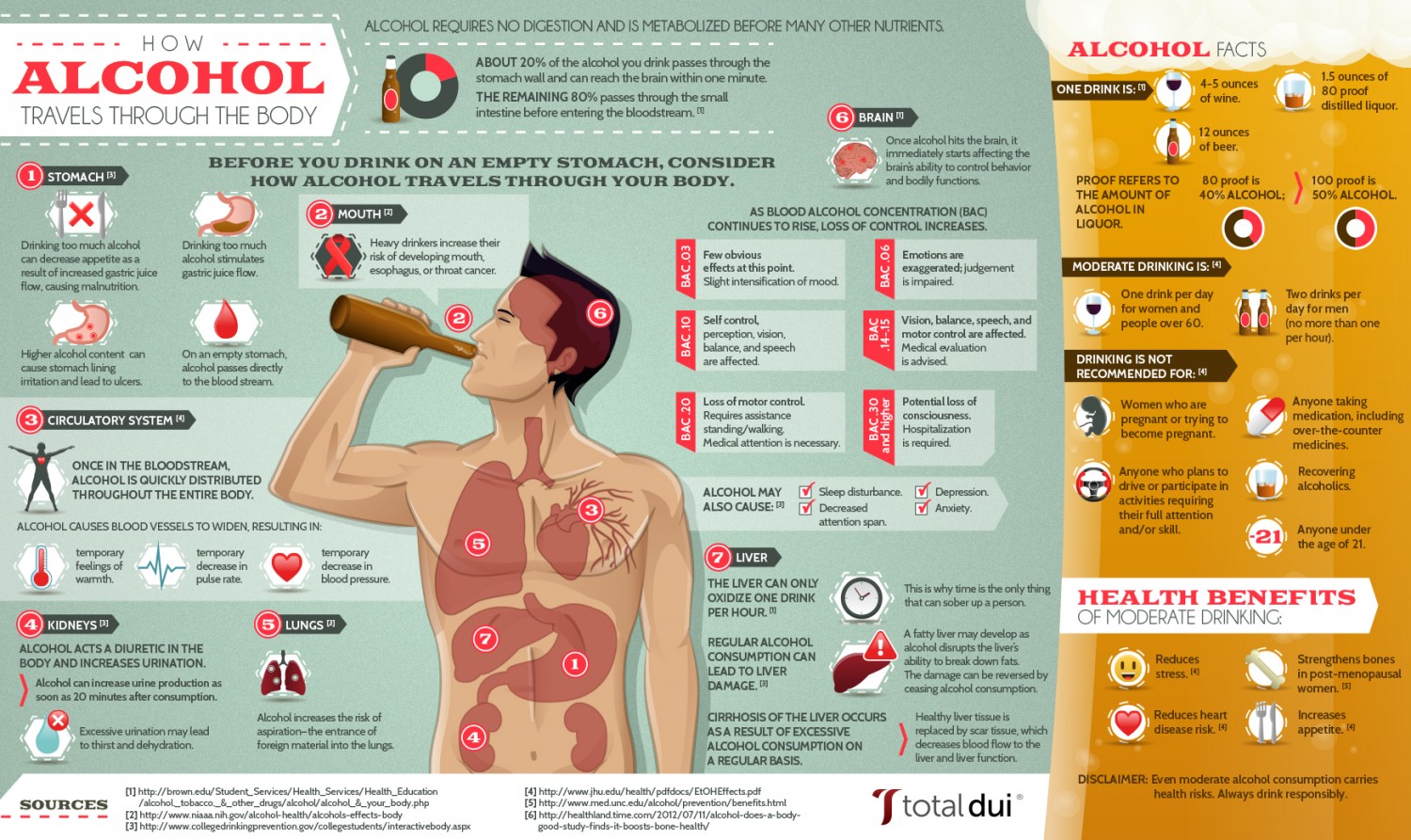
In this pulze, we outline how alcohol travels through the body from the first sip to the moment of elimination. Explore it to learn more about how alcohol works in the body. At the end, feel free to send us your questions and feedback. We value the comments of our readers and do our best to answer all legitimate inquiries personally and promptly.
How Does Alcohol Work In The Body?
1. First, you drink alcohol.
2. Then, alcohol travels from your mouth, through the esophagus, and enters the stomach.
3. Most of the alcohol gets absorbed through the stomach lining – 20%; and small intestine – 80%. Because of this, high blood alcohol concentrations are achieved within 0.5 to 2.0 hours on an empty stomach, or in the average individual within 1.06 to 2.12 hours.
4. On an empty stomach, alcohol can get into the bloodstream and to the brain in 1 minute. But, first, it needs to cross the blood-brain barrier.
5. Alcohol in the brain increases levels of the feel-good neurotransmitter called dopamine. As a result, the brain sends signals to:
i. Increase heart rate and blood pressure
ii. Slow down your reflexes
iii. Reduce your inhibitions
iv. Impair coordination
v. Fog out your sensations and perception
6. Alcohol is broken down and undergoes metabolism in the liver before it can leave the body. About 92-98% of alcohol is broken down and metabolized here.

7. Finally, the remaining 2-8% of alcohol are eliminated from the body through excretion in breath, urine, sweat, feces, breast milk and saliva.
Alcohol Metabolism Is Important!
The rates of absorption, metabolization, and elimination are highly individual and depend on the drinker’s age, body mass, gender, physical health, the level of hydration, whether you’ve eaten or not, and whether you are taking medications or illicit drugs along with alcohol.
Comments
Post a Comment
Please add your comment